
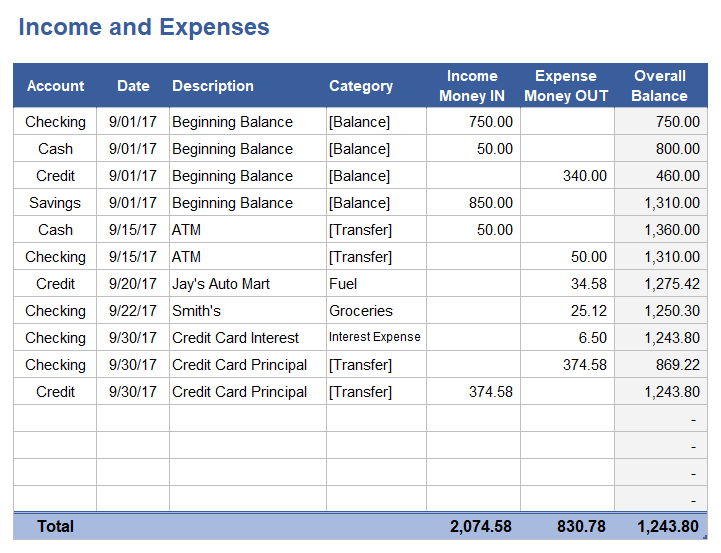
If your monthly income varies, a table based solely on average income may deviate from reality. First, separate your confirmed income from your estimated income, and schedule any expenses that must be paid out. Mark any money that has not yet been received as a fixed balance, ensuring it is not used.
Keep estimated income in a separate column
Record the scheduled deposit date and verification basis, and change the status after the actual deposit. Arrange regular expenses in chronological order to determine how long you can cover them using only confirmed funds. Plan for variable expenses by considering scheduled withdrawals, rather than just the entire remaining amount.
I organize my household ledger along two axes: date and purpose.
Even if the totals of income and expenses match, your account may be empty on the date you need the money. In the monthly table, record the date, item, incoming amount, outgoing amount, and transaction status. List fixed expenses first, and for variable items like living expenses, distinguish between the plan and the actual cost. You must also record card usage dates and the dates when card payments are deducted from your account separately to avoid counting the same expenditure as double spending.
When using a household ledger for consumption analysis, you can record card usage as spending and mark payments as settlements between payment methods. When using it for cash flow analysis, focus on the actual withdrawal date. The key is not to mix and combine the two methods into a single table. At the end of the month, select only two or three items that resulted in significant discrepancies to reflect in the following month's plan, and do not treat one-time refunds or bonuses as recurring monthly income.
If the expected deposit is delayed
For illustrative purposes, if a deposit scheduled for the 15th is changed to the 20th, the interim balance changes even if the total monthly income remains the same. Modify the deposit date and recalculate the withdrawals from the 15th to the 20th. For the following month, do not assume the same delay as a confirmed fact; instead, classify it as an unconfirmed item.
Location to modify in the table when income changes
If the schedule changes, we do not stop at merely adjusting the amount. We distinguish between estimates and confirmed transactions until the actual deposit is verified, and check the impact of the date change on other withdrawals. We maintain the status of records to ensure that already confirmed expenses are not unconditionally offset against estimated income.
| change | Column to modify | Items to view again |
|---|---|---|
| Deposit delay | Expected deposit date | Intermediate balance |
| Change amount | Estimated revenue | Remaining allocation |
| Actual deposit | Confirmed status | Compare with original history |
Checklist to check yourself
- Confirmed and projected revenue
- Deposit date
- Mandatory withdrawal
- Intermediate balance
- Actual deposit confirmation
Frequently Asked Questions
Can't I set a budget based on my recent average income?
While averages can be a reference, they cannot replace the timing of this month's deposits or their confirmation. Separating confirmed earnings from estimated income allows you to identify areas for adjustment in the event of delays. The key is not to calculate daily balances based solely on the average value.
When looking further into this topic 월간 수입과 지출 기록 You may also refer to the following. Read the content based on the questions summarized above, and record the actual amounts or applicable conditions by comparing them with the original data of the relevant transaction. The linked page is in Korean.